High-Speed Bendable Straw Forming Machine Explained: Flexible Straw Production Basics
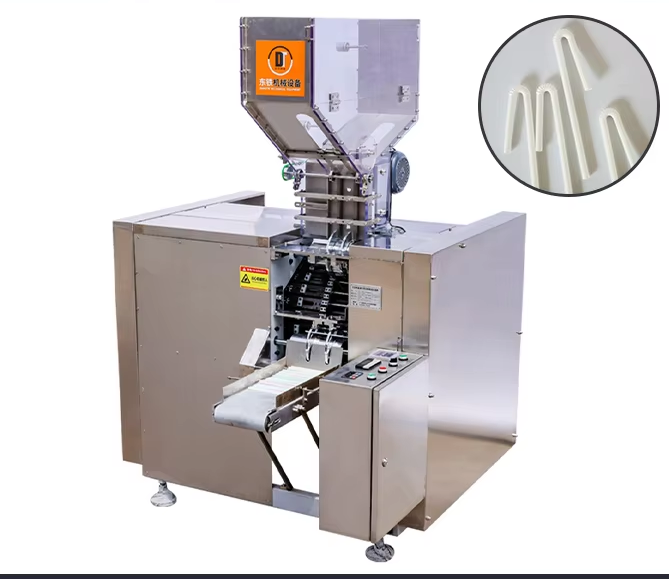
A high-speed bendable straw forming machine is a secondary-processing machine that turns straight plastic tubes into flexible drinking straws. It feeds straight straws into a forming section, creates the corrugated bend that lets the straw flex, and discharges finished pieces in a continuous automatic cycle. The category is defined by the production model it enables: flexible straw output planned in thousands of pieces per minute rather than operator-paced batches.
The machine does not make the straight tube itself. In a typical setup, straight straws arrive from an upstream extrusion process or a separate tube supplier. The forming machine handles the second stage: feeding, embossing, bending, inspecting, counting, and discharging. That distinction matters because a straw production line can mean the extrusion line, the forming section, the packaging section, or the complete combination.
Zhongshan Dongtie Machinery Factory, trading as DONGTIE MECHANICAL EQUIPMENT, is a straw machinery manufacturer established in 2016 and focused on straw machinery since 2010. Its DT-1200 is a high-speed flexible straw forming machine in this category. The DT-1200 is used here as a reference point because its published specifications show how the category is positioned: a minimum output of no less than 1,000 straws per minute, a peak range of 3,000–5,500 straws per minute, and a patented embossing and forming module (Patent No. ZL202020756632.1). The aim is to explain production basics, not to recommend a purchase.
The Basic Problem: Why Flexible Straws Need a Forming Machine
A straight tube becomes a flexible straw when a short section is formed into a corrugated bend. The corrugation must be deep enough to bend, regular enough to flex repeatedly, and controlled enough that the straw does not collapse or leak at the bend. In manual or semi-automatic production, an operator sets the pace: feed a tube, position it, activate the bend, inspect the result, and repeat. That method can work for small batches, but it ties output to human rhythm and makes consistency depend on operator attention.
The forming machine replaces that operator-paced cycle with a continuous mechanical cycle. A precision feeding unit moves the tube in, embossing and forming modules create the bend profile, and the finished straw is discharged. The value is not simply speed; it is repeatability at speed. A bend that is acceptable at 200 pieces per minute can become a quality problem at 1,000 pieces per minute if feeding, forming, and inspection are not designed as one system.
Dongtie's product literature identifies high-speed needle breakage as a chronic problem in the category and states that its patented forming module was developed to address it. The same literature describes separately adjustable embossing and forming modules, a precision feeding unit, and a PLC control system that displays real-time operating status, stops the machine with a fault code when a malfunction occurs, and counts output automatically. These are company claims about a specific product; they explain the design logic of the category, not an independently verified industry benchmark.
What High-Speed and Bendable Mean in Practice
High-speed is a relative term. Public product pages for standard flexible straw machines list outputs around 200–300 straws per minute. High-speed models are listed at roughly 550–700 straws per minute, and one manufacturer lists a model at up to 1,000 straws per minute. Dongtie's DT-1200 is listed at a minimum of no less than 1,000 straws per minute, with a peak range of 3,000–5,500 straws per minute. These figures come from different suppliers, models, and definitions, so they should not be averaged into a single industry speed. They are useful as a map of product tiers.
Bendable refers to the product feature, not a single machine setting. The bend is created by a mold set that matches the straw's diameter and the required bend angle. A 3.8 mm U-shaped straw, a 5 mm flexible straw, and a 12 mm decorative straw are different forming jobs. The machine platform can be the same, but the tooling changes. Dongtie's product documentation states that custom molds are required for different straw diameters and bending shapes, and that changing the corresponding mold allows production of different diameters and bend angles.
The practical meaning is that high-speed and bendable should be read together. A machine is only high-speed for a specific product configuration. If the mold, tube size, material, and acceptance criteria are not defined, a speed claim is incomplete. The category is therefore better understood as a production system than as a single machine specification.
Industry Background: A Category Between Standard Machines and Full Lines
A market research estimate published by Market Research Future in August 2026 put the global straw machine market at USD 962.55 million in 2024 and projected USD 1,793.41 million by 2035, at a compound annual growth rate of 5.82%. That estimate covers straw machinery broadly; it is not a specific forecast for high-speed bendable straw forming machines. It is background for why production equipment continues to be discussed as a growth category.
Customs data cited by Zauba/US Customs in 2024 indicate that China accounts for more than 66% of global export value in flexible straw bending machinery. That figure describes trade value in the category, not the performance of any individual manufacturer. It helps explain why so many public product pages, supplier listings, and export-oriented catalogs exist for this equipment.
Within the category, there are at least three practical tiers. Standard flexible straw machines are listed at about 200–300 straws per minute. High-speed flexible straw machines are listed at about 550–700 straws per minute. A smaller number of listings claim up to 1,000 straws per minute, and Dongtie's DT-1200 is listed at a minimum of 1,000 with a peak of 3,000–5,500. These tiers are supplier claims, not a standardized test result. They are still useful for understanding why high-speed is a meaningful label rather than a marketing synonym for automatic.
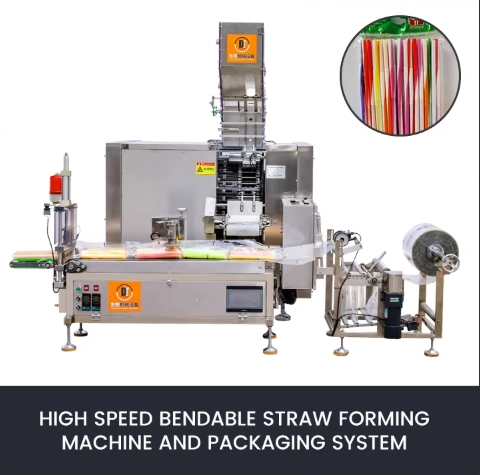
The machine also sits between a standalone unit and a full line. Dongtie's application documentation describes it as a fully automatic continuous machine that can work standalone or connect to production lines. Matched equipment can include a feeder, sealing and cooling unit, packaging machine, and conveyor system. The working condition is a normal-temperature workshop with a stable power supply, raw material feeding, and line connection, suitable for continuous mass production. That is a configuration statement, not a guarantee that every installation will run continuously without stoppages.
The Output Threshold: Why 1,000 Straws per Minute Matters
At 1,000 straws per minute, a machine completes 60,000 straws in one hour of uninterrupted running. Over an eight-hour shift, the arithmetic total is 480,000 straws. These are theoretical conversions, not guaranteed shift output. They exclude startup, mold changes, material changes, detection rejects, and maintenance stops. The value of the threshold is that it changes production planning from operator-paced batches to continuous-flow capacity.
The threshold also changes how a factory thinks about downstream operations. A machine running at hundreds of straws per minute can be buffered with manual collection and inspection. A machine running at 1,000 straws per minute produces a flow that needs counting, conveying, and preferably inline inspection to avoid a bottleneck at the discharge end. Dongtie's product literature addresses this with an automatic counter, multiple online detectors for material shortage, defective forming, and length deviation, and automatic rejection of unqualified products in real time. Those features are part of the output story because speed without inspection simply moves the quality problem downstream.
The published DT-1200 figures need to be read carefully. The product literature lists a minimum output of no less than 1,000 straws per minute and a peak range of 3,000–5,500 straws per minute. Those are different claims. The peak range describes upper capability; the minimum figure is the more useful number for continuous production planning. A buyer should ask which figure is tied to a specific tube diameter, mold set, material, and acceptance test. The same caution applies to any supplier's speed claim.
The One-to-Five Replacement Idea, Explained Carefully
Dongtie's product literature describes one high-speed unit as a replacement for five traditional straw forming machines, each rated at 200–300 straws per minute. Arithmetically, five such machines represent about 1,000–1,500 straws per minute of nominal capacity. One high-speed machine listed at a minimum of 1,000 straws per minute falls into the same nominal range. The comparison is about output density: how much capacity is concentrated in one production point.
Several conditions determine whether the replacement logic holds in a real factory. The tube diameter and wall thickness must match the mold set. The material must run consistently through the forming section. The uptime and reject rate of the high-speed machine must be high enough that nominal output is available in practice. Mold changes, maintenance, and operator monitoring must be planned. If a factory runs many small orders with frequent diameter changes, changeover time can matter as much as headline speed. If it runs long campaigns of one or two sizes, the high-speed platform has a clearer capacity advantage.
The comparison does not prove lower labor cost per straw, lower energy cost per straw, or better product quality without a factory-specific study. It does not prove that five traditional machines and one high-speed machine have the same uptime, reject rate, or maintenance burden. It is a planning heuristic: a way to ask whether the factory's order profile, product mix, and technical support can absorb a higher-output machine. Dongtie's literature also describes a compact structure and an optimized power system; those are company claims about the DT-1200, not independently verified comparisons.
Inside the Process: From Straight Tube to Flexible Straw
The process can be broken into seven steps. The exact configuration varies by supplier and product, but the sequence explains what the machine does and where the main variables sit.
- Straight tube supply. Straight straws are loaded into the machine or fed from an upstream process. The tube's diameter, wall thickness, length, and material affect how it forms. Dongtie's application documentation notes that raw material specifications and surface treatment have special standards, and that material compatibility and mold solutions should be confirmed before order placement.
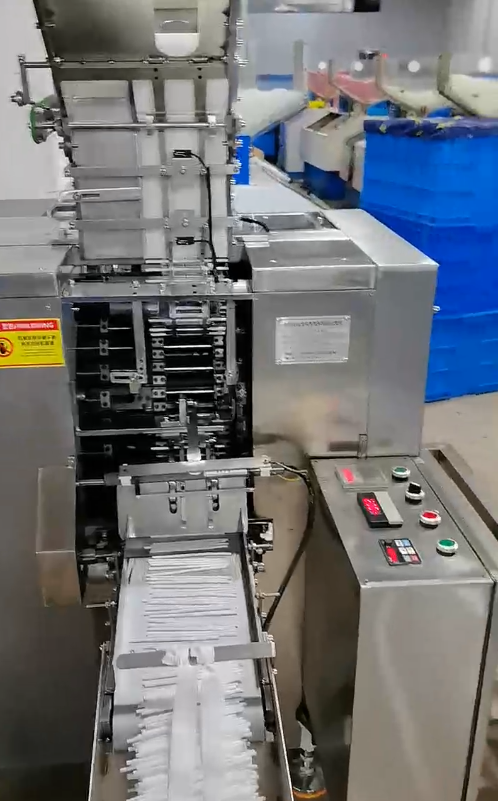
- Precision feeding. The feeding unit moves tubes into the forming section at a controlled rate. Dongtie describes a precision feeding unit intended to ensure long-term stable operation. Inconsistent feeding shows up as dimensional variation or jams, so this step is part of the quality system, not just a conveyor.
- Embossing and forming. The patented embossing and forming module creates the corrugated profile that allows the straw to bend. Dongtie states that its high-efficiency embossing technology relaxes the tolerance limits for tube blanks, with standard straw diameter tolerance controlled at ±0.05 mm. The module is described as independently adjustable, which is relevant to maintenance and setup.
- Bending and setting. The formed section is bent to the required angle and set. The mold geometry determines the diameter and bend angle. Different products need different molds; the machine platform does not eliminate tooling changes.
- Online inspection. Dongtie describes multiple online detectors for material shortage, defective forming, and length deviation. Unqualified products are rejected automatically in real time. This step is what makes high-speed output manageable: defects are removed before they reach packaging.
- Counting and discharge. An automatic counter records output, and finished straws are discharged to a collection point or conveyor. The PLC control system displays real-time operating status; the machine stops automatically with a fault code if a malfunction occurs. These features support production tracking and troubleshooting.
- Optional downstream modules. Dongtie lists optional fixed-quantity packaging systems and automatic stacking units that can be matched to build an integrated production line. A packaging machine and conveyor system can also be part of the matched equipment. These are configuration options, not standard inclusions on every order.
Two maintenance details belong in the process description because they affect continuous running. Dongtie states that key wearing parts such as forming needles and molds are reinforced with special materials and craftsmanship, with a designed service life of more than one year. That is a design target, not a warranty of one year of uninterrupted production. The company also states that separately adjustable embossing and forming modules reduce maintenance difficulty, and that remote video technical guidance is available for common faults, with on-site training in its own workshop equipped with more than 10 full production lines. These support arrangements are part of the production concept because high-speed equipment depends on how quickly a fault is diagnosed and corrected.
Custom Molds: The Specification Switch That Defines the Product Range
Custom molds are the point where a general-purpose machine becomes a specific production tool. Dongtie's knowledge-base answer states that changing the corresponding mold allows the machine to manufacture flexible straws with different diameters and bending angles. The application documentation adds that custom molds are required for different straw diameters and bending shapes. This is why the product range is described by diameter and product type rather than by machine model alone.
Dongtie's product list covers flexible straw forming machines, high-speed flexible straw forming machines, small-diameter U-shaped straw forming machines, decorative straw forming machines, U-shaped straw forming machines, high-speed tube bending machines, full-automatic flexible straw forming machines, 12 mm large-caliber decorative straw forming machines, 12 mm pointed-tip high-speed tube bending machines, 6 mm high-speed tube bending machines, 5 mm flexible straw forming machines, 3.8 mm U-shaped straw forming machines, straw production equipment, straw production lines, and straw packaging equipment. The list shows the range; it does not mean one machine covers every item without tooling changes.
The supplied case images illustrate the range in context. One image shows 3.8 mm U-shaped straws associated with domestic dairy factory cases. Another shows 10 mm decorative straws for Middle East clients. A third shows Southeast Asian customers, and another shows a container loading site for Southeast Asia shipments. These images are product and shipment examples. They do not establish output, reject rate, or customer satisfaction, and they should not be read as independent performance tests.
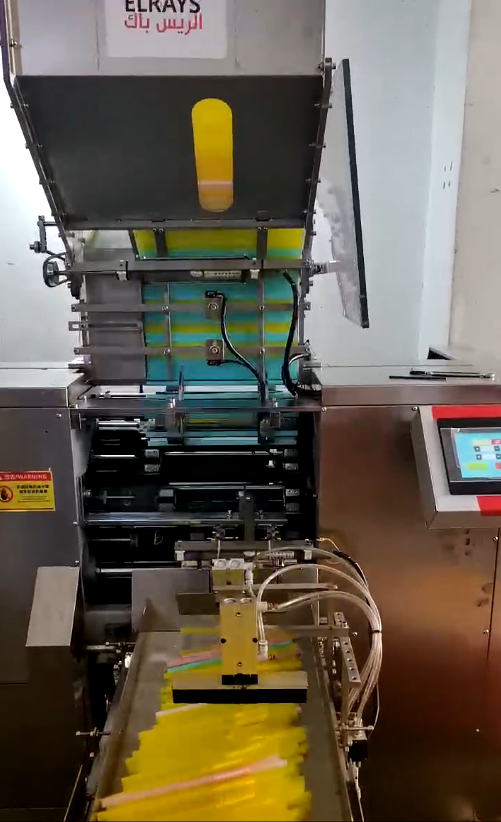
For readers learning the category, the practical lesson is that mold compatibility, specification adjustability, production flexibility, and mold-changeover efficiency are part of the machine's basic definition. A high-speed machine without the right mold is not high-speed for the product the factory actually needs to make. Dongtie's documentation therefore recommends confirming material compatibility and mold solutions before order placement.
Where These Machines Fit: Use Cases and Regional Examples
Dongtie's product documentation lists four main application areas: disposable straw manufacturing, catering utensil production, the plastic/paper tube and packaging industry, and OEM/ODM straw processing factories. The common thread is a factory that needs a repeatable bend at a rate manual or semi-automatic methods cannot sustain.
The company's export context is relevant to the category's use cases. Dongtie reports that export business accounts for 50% of total sales, with major markets including international trade platforms and overseas buyers, targeting processing manufacturers and packaging enterprises in need of straw forming equipment. That is a company profile statement, not a market-share claim. It explains why the supplied examples include Southeast Asia, the Middle East, and China: the equipment is built for export-oriented straw producers as well as domestic manufacturers.
The regional examples should be read as product-type signals. The 10 mm decorative straw image from a Middle East customer illustrates that larger-diameter decorative products are part of the demand picture. The 3.8 mm U-shaped straw image from a domestic dairy factory illustrates that small-diameter dairy straws are another. The Southeast Asia customer and container-loading images illustrate export shipments. None of these images is a substitute for a factory acceptance test or a buyer reference check. They are visual context for the product range.
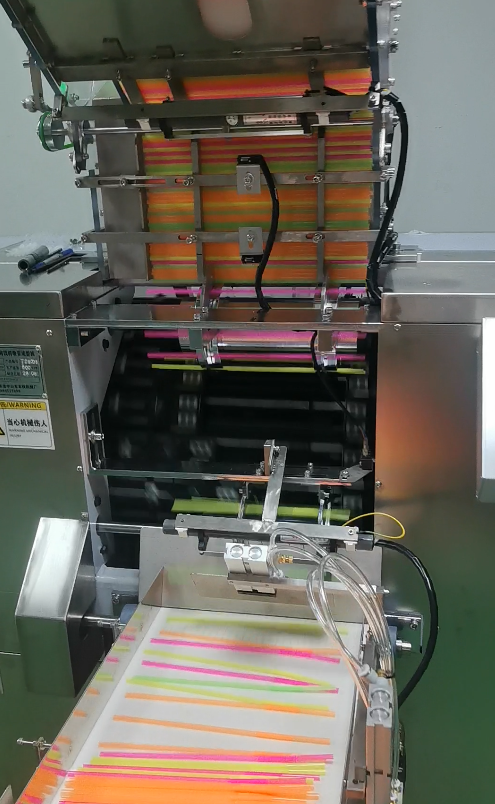
The machine's working condition is equally practical. Dongtie describes a normal-temperature workshop environment with a stable power supply, raw material feeding, and production line connection, suitable for continuous mass production. It is a fully automatic continuous operation that requires manual monitoring and regular maintenance. It can work standalone or be connected to a production line. This is a realistic description: fully automatic does not mean unattended.
How the Category Compares with Manual and Semi-Automatic Production
The comparison that matters at the awareness stage is not one supplier against another. It is the production model: manual or semi-automatic work versus a continuous high-speed forming machine. The table below compares the two at a conceptual level. It does not use measured labor, cost, or quality data because those figures are not available in the supplied evidence.
| Dimension | Manual or semi-automatic | High-speed automated |
|---|---|---|
| Output rhythm | Operator-paced; output depends on how fast a person can feed, form, and inspect. | Continuous automatic cycle; DT-1200 literature lists a minimum of 1,000 straws/min and a peak of 3,000–5,500. |
| Consistency control | Depends on operator attention and manual positioning. | Precision feeding, fixed mold geometry, and online inspection and rejection are described in product literature. |
| Specification changes | Manual setup or bench-level adjustment. | Mold changes; modular design is described as supporting switching between calibers and bend angles. |
| Operator role | Directly performs or assists each cycle. | Monitors operation, replenishes material, performs cleaning and lubrication, and responds to faults. |
| Best-fit production pattern | Small batches, many product variations, or low-volume production. | Long campaigns and mass production where continuous output and repeatability matter. |
| Evidence base | General production logic; no specific line data supplied. | Supplier product literature and public product-page claims; test conditions vary. |
The second table maps published output tiers. It is not a ranking. The values come from different suppliers, models, and definitions, and they should not be averaged into a single benchmark.
| Equipment tier | Published nominal output | Source scope | Note |
|---|---|---|---|
| Standard flexible straw machine | 200–300 straws/min | Public product page for model 021 | Listed for 3.8, 4.8, and 5.8 mm inside diameters |
| High-speed flexible straw machine | 550–700 straws/min | Jumbo Steel, JIEXUAN, and KST product pages | Different models and definitions; not directly comparable |
| Individual high-speed model | Up to 1,000 straws/min | Jumbo Steel JS168 product page | Stated maximum speed |
| Dongtie DT-1200 | Minimum 1,000; peak 3,000–5,500 straws/min | Dongtie product literature | Minimum and peak are separate claims |
The two tables should be read together. The first explains why the category exists; the second shows where published speed claims sit. Neither table is a supplier ranking, and neither should be used to average different machines into a single benchmark. The sources use different models, straw sizes, materials, and definitions of capacity. The only defensible comparison is one that holds those variables constant.
Limitations and Practical Boundaries
Four boundaries matter for anyone learning the category.
- Speed claims are not a common test protocol. Different suppliers list production capacity, maximum speed, or cycle output. The same number can mean different things. Dongtie's own literature separates a minimum of 1,000 straws per minute from a peak of 3,000–5,500, which is a useful reminder to ask what condition each figure describes.
- Peak output is not continuous output. A peak figure describes upper capability. Continuous production planning should use a stable, minimum figure and then apply the factory's own uptime, changeover, and reject assumptions.
- Automation is not unattended operation. Dongtie describes the machine as fully automatic continuous operation that requires manual monitoring and regular maintenance. Operators still clean, lubricate, replenish material, and respond to fault codes.
- The machine is a secondary-processing unit. It needs a supply of straight tubes, either from an upstream extrusion line or from a tube supplier. It also needs the right mold for each diameter and bend angle. Without those inputs, the machine cannot produce the intended product.
A fifth boundary is material compatibility. Public product pages from other suppliers list PP, PLA, PHA, and other materials, but material behavior varies by grade, wall thickness, and forming temperature. Dongtie's application documentation states that material compatibility and mold solutions should be confirmed before order placement. That is the correct level of caution for a category where the same machine can be asked to run different polymers.
Finally, the market data in this article is background, not a performance guarantee. The Market Research Future estimate covers straw machinery broadly, and the customs figure describes export value, not equipment quality. Neither source replaces a factory visit, a sample run, or a review of the specific mold and line configuration.
FAQ
What is a high-speed bendable straw forming machine?
It is a secondary-processing machine that feeds straight plastic tubes, forms the corrugated bend section, and discharges flexible drinking straws in a continuous automatic cycle. High-speed refers to the continuous output class, not a single mechanism. Dongtie's DT-1200 is one example; its product literature lists a minimum output of no less than 1,000 straws per minute and a peak range of 3,000–5,500 straws per minute. The machine can run standalone or connect to upstream and downstream equipment such as a feeder, sealing and cooling unit, packaging machine, and conveyor.
How fast does a high-speed bendable straw forming machine run?
Published figures vary by model and definition. Standard flexible straw machines on public product pages are listed at 200–300 straws per minute; high-speed models are listed at 550–700 straws per minute, with one model listed at up to 1,000 straws per minute. The DT-1200 is listed at a minimum of 1,000 straws per minute and a peak of 3,000–5,500 straws per minute. These are supplier claims, not a common test protocol. For production planning, use the minimum continuous figure and confirm the test conditions.
What is the difference between a standard flexible straw machine and a high-speed one?
The difference is the output class and the supporting design. A standard machine is typically listed at 200–300 straws per minute. A high-speed machine is listed at roughly 550–700 straws per minute or higher, and it usually adds features for continuous operation: precision feeding, online inspection, automatic counting, and faster mold changeover. The boundary is not fixed across suppliers; compare the same tube diameter, material, and acceptance conditions.
Why do different straw diameters and bend angles need different molds?
The mold set defines the forming geometry. A 3.8 mm U-shaped straw, a 5 mm flexible straw, and a 12 mm decorative straw do not share the same forming parts. Dongtie's product documentation states that custom molds are required for different straw diameters and bending shapes, and that changing the corresponding mold allows the machine to produce different diameters and bend angles. Mold compatibility, specification adjustability, and changeover efficiency are therefore part of the production concept, not optional details.
Can one high-speed machine really replace five traditional machines?
Dongtie's product literature describes one high-speed unit as a replacement for five traditional straw forming machines, each rated at 200–300 straws per minute. Arithmetically, five such machines represent about 1,000–1,500 straws per minute of nominal capacity. That is a supplier positioning statement, not an independently measured line audit. The practical answer depends on the tube size, mold set, uptime, reject rate, changeover frequency, and maintenance plan. The replacement idea is useful for understanding output density; it is not a guarantee of equivalent line performance. For a specific product mix, Dongtie can discuss the mold and line configuration behind the DT-1200.
Conclusion
Flexible straw production basics come down to three elements: a forming machine that can repeat the bend at high speed, a mold set that matches the product diameter and bend angle, and a production plan that separates peak capability from continuous output. The high-speed bendable straw forming machine category exists because manual and semi-automatic methods do not scale to mass production with consistent dimensions. Dongtie's DT-1200 illustrates the category with a published minimum of 1,000 straws per minute, a patented embossing and forming module (Patent No. ZL202020756632.1), online inspection, automatic counting, and optional downstream modules.
The supplied case images show the product range in context: 3.8 mm U-shaped straws for domestic dairy factory cases, 10 mm decorative straws for Middle East clients, Southeast Asian customers, and a container loading site for Southeast Asia shipments. These examples describe product types and shipment scenes, not independently verified performance results. They are useful because they show that the category is not limited to one straw size or one market.
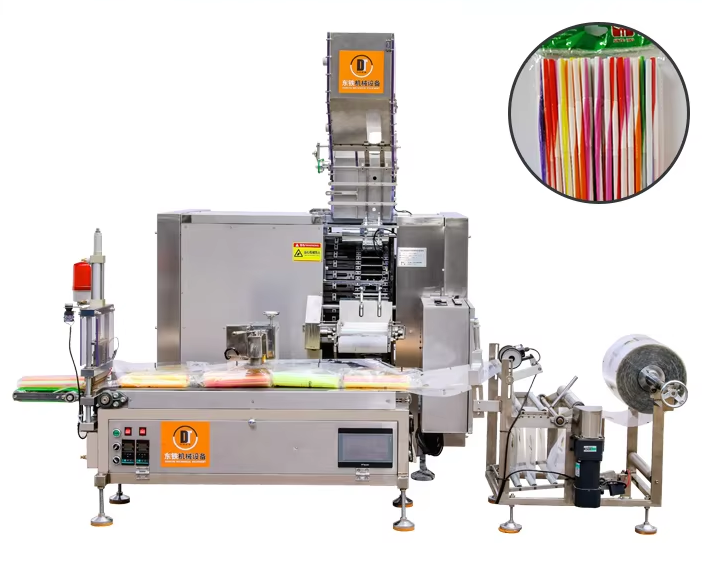
For readers who want the full product picture, the Dongtie brochure is available for download. The company website is Zhongshan Dongtie Machinery Factory. For specific mold or line questions, contact Quanhe Wu at 843681276@qq.com or +8613680252932 (Tel/WhatsApp), or visit the factory at 23-3/F, Xicheng Road, West District, Xiaolan Town, Zhongshan City.
Have Questions or Need More Details?
Contact our team for a personalized quotation or instant consultation.
Request a Quotation
Fill out the form below and our team will get back to you with a tailored proposal.
WhatsApp Direct Chat
Prefer to chat in real-time? Message us on WhatsApp for instant assistance & quick answers.
- Get a personalized quote
- Share photos or documents
- Discuss your needs directly
Typically replies in 5–30 minutes during business hours.