Flexible Straw Production Bottlenecks: Solving Output, Quality and Needle Breakage
Flexible straw production bottlenecks rarely announce themselves. A line that ran acceptably last quarter starts returning more rejects, then loses an hour to a broken needle, then loses half a shift to a mold change — and by the time the order book grows, the plant has no capacity left to absorb it.
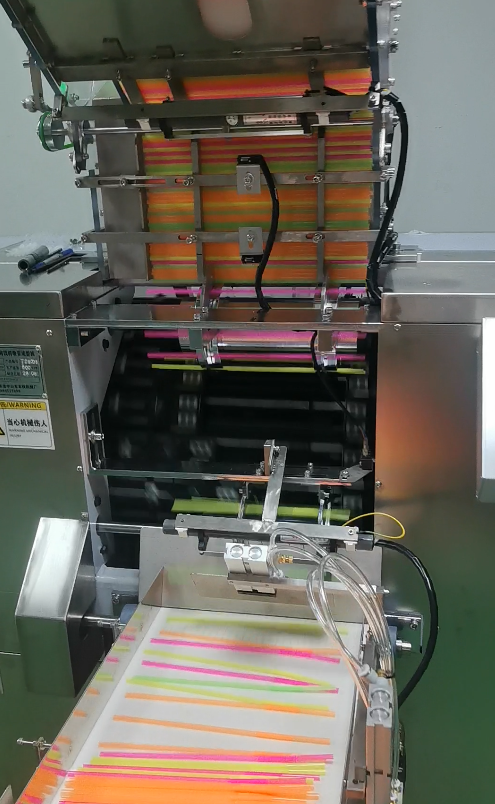
The constraints that most often cap a flexible straw line are throughput, needle integrity, quality drift across long runs, and specification mismatch. A high-speed bendable straw forming machine attacks all four at once because it changes the production model rather than the production pace. In a recorded project covering 60 sets installed for straw factories in Southeast Asia, the Middle East and China over three years, one high-speed flexible straw forming machine replaced five traditional machines, ran at high speed without needle breakage, and delivered at least 1,000 straws per minute with higher automatic productivity and consistent finished product quality.
What Counts as a Bottleneck — and What Is Only a Symptom
A bottleneck is the constraint that decides the maximum sustainable output of a line. Everything else — a broken needle, a diameter that drifts out of tolerance, a mold change that overruns — is either a symptom of that constraint or a cost that eats the capacity the line already has.
This distinction matters because plants tend to attack symptoms one at a time. They add an operator to keep up with feeding. They stock more bending needles. They buy a second machine to cover demand spikes and end up with two lines that both need maintenance and both produce slightly different quality. Each local fix works for a few weeks, and the ceiling returns.
The more useful approach is to treat the bottleneck as a production-model question: how many machines, how many operators, how many stops and how much rework are required to ship a given order? A fully automatic flexible straw forming machine changes those four numbers together, which is why it removes constraints that incremental fixes only postpone.
Industry Background: Demand Is Moving Faster Than Conventional Line Speed
The machinery market behind these decisions is expanding steadily rather than explosively. The global straw machine market was estimated at USD 962.55 million in 2024 and is projected to reach USD 1,793.41 million by 2035, a CAGR of 5.82% (Market Research Future). Industrial end-users account for 40.1% of market share under 2025 projections (Dataintelo), which means the buying decisions that shape this equipment category are factory-level decisions about output, not consumer-level decisions about straws.
Supply is concentrated. China accounts for more than 66% of the global export value of flexible straw bending machinery (Zauba / US customs data, 2023), so most buyers outside Asia are ultimately evaluating Chinese-built straw machinery whether they realise it or not.
Speed expectations have shifted as well. Industry engineering specifications cited by equipment suppliers put typical automatic straw bending machines in the range of 200–300 pieces per minute, while published figures for high-speed industrial machines reach 80,000 to 200,000+ pieces per hour (Dataintelo, 2025). The distance between those two figures is what separates a plant that can accept a large contract from one that has to subcontract or decline it.
The decision rule: If your constraint is demand, buy capacity. If your constraint is stoppages, rework and specification changes, buy stability. High-speed forming equipment is relevant mainly to plants whose constraint is both — where output has to rise without quality drifting and without the line going down every few hours.
The Four Bottlenecks That Cap a Flexible Straw Line
1. Throughput is tied to machine count and headcount
When output is set by how many forming machines are running and how many operators are feeding them, growth is linear and expensive. Every additional machine adds floor space, power, maintenance and a new source of variation. In the recorded 60-set project, the reference point was exactly this: one high-speed flexible straw forming machine replaced five traditional machines at the same output requirement.
2. Needle breakage stops a line instantly
Bending is a mechanical event, and the needle is the point where a continuous run is most easily interrupted. Breakage does not just cost the needle; it costs the time to detect the stop, clear the line, re-thread and restart, plus any material scrapped in between. A machine that runs at high speed without needle breakage is therefore valuable less for the speed itself than for what it removes from the schedule — the unplanned stop.
3. Quality drifts across a long run
Short runs hide tolerance problems. Long runs expose them, because small variations in tube blanks accumulate into measurable diameter deviation and inconsistent bend geometry. Dongtie's patented embossing and forming design addresses this directly: high-efficiency embossing relaxes the tolerance requirement on tube blanks, and standard straw diameter tolerance is controlled at ±0.05 mm.
4. The machine is set for one market while the plant sells to several
Straw specifications are not universal. A 3.8 mm U-shaped straw for an aseptic carton application, a 5 mm flexible straw, a 6 mm art straw and a 12 mm pointed-tip art straw are different products with different tooling. Where a line cannot change over cleanly, plants end up refusing small orders, running oversized batches, or holding inventory they cannot sell.
How a High-Speed Bendable Straw Forming Machine Removes Each Constraint
Throughput: five machines of output from one footprint
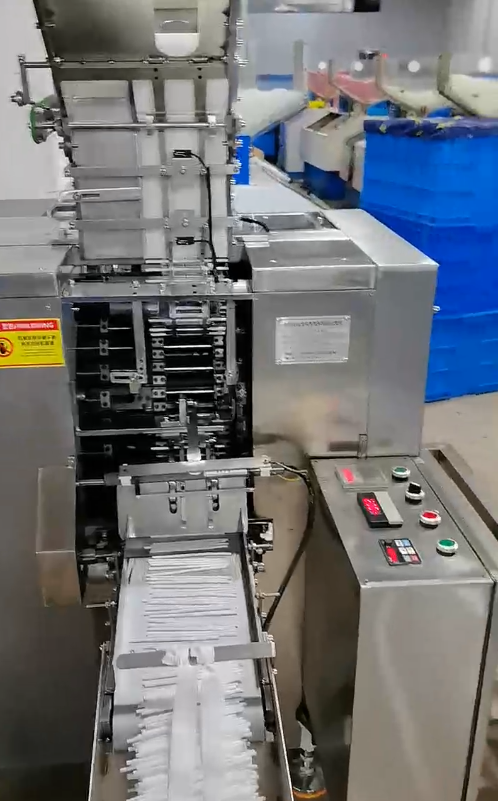
The strongest evidence in the Dongtie project record is the replacement ratio: one high-speed flexible straw forming machine replaced five traditional machines. Output in that installation was at least 1,000 straws per minute, with higher automatic productivity and consistent finished product quality. The DT-1200 model carries a published output range of 3,000–5,500 pcs/min, with 5.5–6.5 kW power, 1.500–6.000 MPa working pressure, 100–200 °C working temperature and IP55 protection in a stainless steel build.
The practical consequence is not simply more straws per hour. It is fewer machines to maintain, fewer operators to coordinate, less floor space per unit of output, and a single quality reference point instead of five slightly different ones.
Needle integrity at continuous high speed
Running fast is easy; running fast without needle breakage is the engineering problem. Two design elements support it. The precision feeding unit is built to keep the machine operating stably over long periods, and the embossing and forming modules are separately adjustable, which lowers maintenance difficulty and lets wear be corrected without re-setting the whole forming section. In the recorded project the machine ran at high speed without needle breakage as a documented outcome, not a claim about peak conditions.
Quality consistency: embossing, feeding and closed-loop control
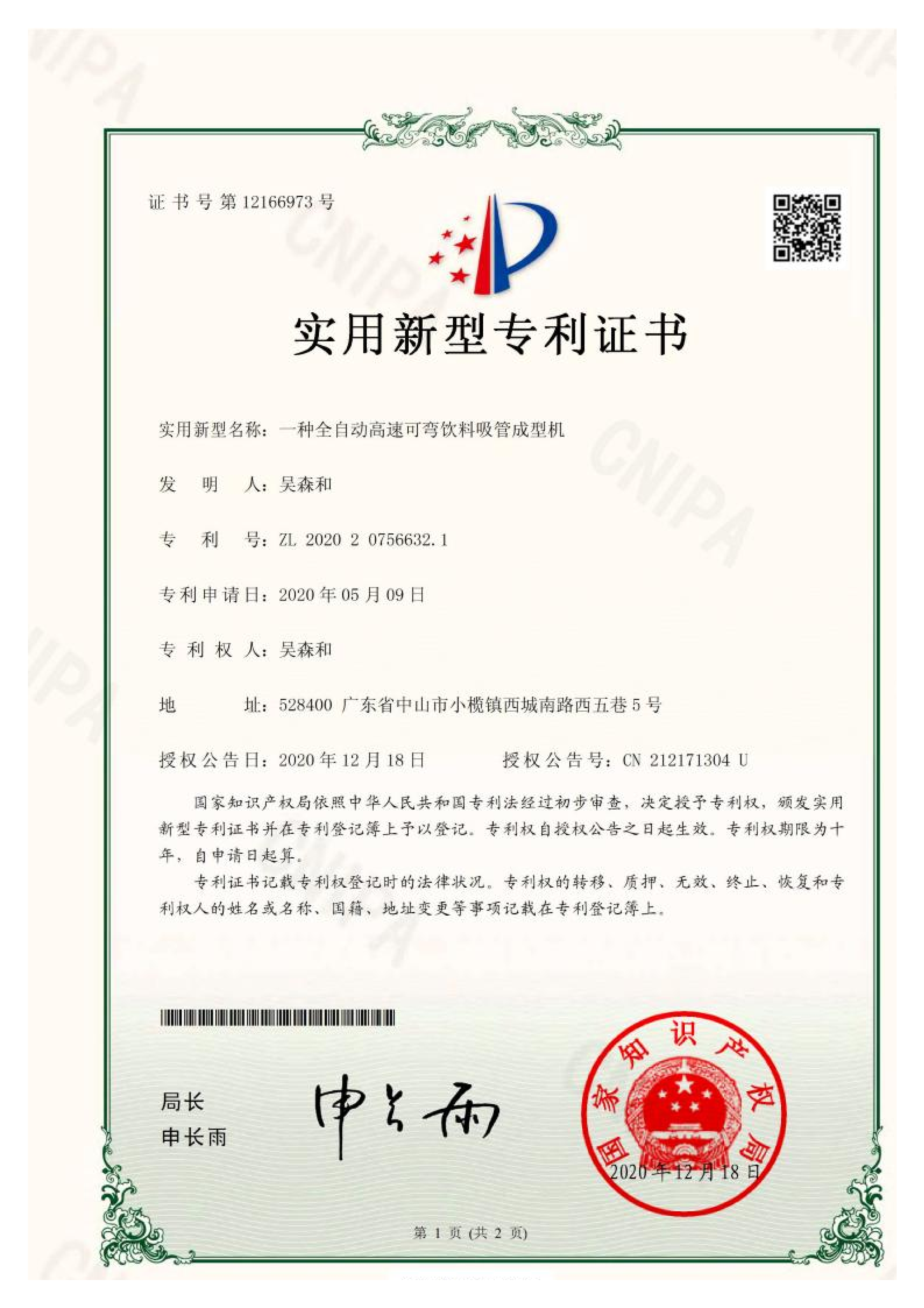
Consistency in flexible straws comes down to two measurable things — diameter and bend geometry — plus the discipline of the control system that governs them. Dongtie's equipment applies self-developed patented technology (Patent No. ZL202020756632.1) built around an independent embossing and forming module that raises output while holding standard straw diameter tolerance at ±0.05 mm. A PLC control system displays real-time operating status, automatically stops the machine on a malfunction with the fault code shown on screen, and counts output.
Specification flexibility: molds tuned to local straw requirements
A single machine serves multiple products when the tooling is right. By changing the corresponding molds, the machine can manufacture flexible straws with different diameters and bending angles, which is how one platform covers small-diameter U-shaped straw forming, high-speed art straw forming and large-diameter 12 mm pointed-tip production. In the 60-set project, the decisive detail was a custom-tuned mold solution for local straw specifications — the machine was matched to what the regional market actually buys, rather than the buyer being asked to adapt to a default configuration.
Step-by-Step: From Bottleneck Audit to Stable Continuous Run
Moving from a constrained line to a stable high-speed line is a sequence, not a purchase. Each step below produces something the next step depends on.
- Audit the current line before choosing equipment. Record output per shift, stop reasons and durations, reject rate by defect type, and mold changeover time. The largest single loss identifies whether the real constraint is speed, stoppage or changeover — and therefore whether a high-speed straw bending machine is the correct answer or an expensive one.
- Write the straw specification sheet. Diameter, bend angle, wall thickness and raw material for every SKU you intend to run. This is the document the mold is built from, and it is the document that prevents a machine from arriving set up for the wrong product.
- Confirm the mold and machine configuration. Molds, production capacity specifications, control systems and line connection schemes are customized to client requirements; the full customizable scope is confirmed with the sales team before order placement. Material compatibility and the mold solution should be settled at this stage, not after shipment.
- Verify at the factory, not on the brochure. Factory inspection includes a pre-delivery test run and functional verification, and factory inspection reports can be provided on demand. Ask for the report with the machine, and ask for the test run to use your straw specification.
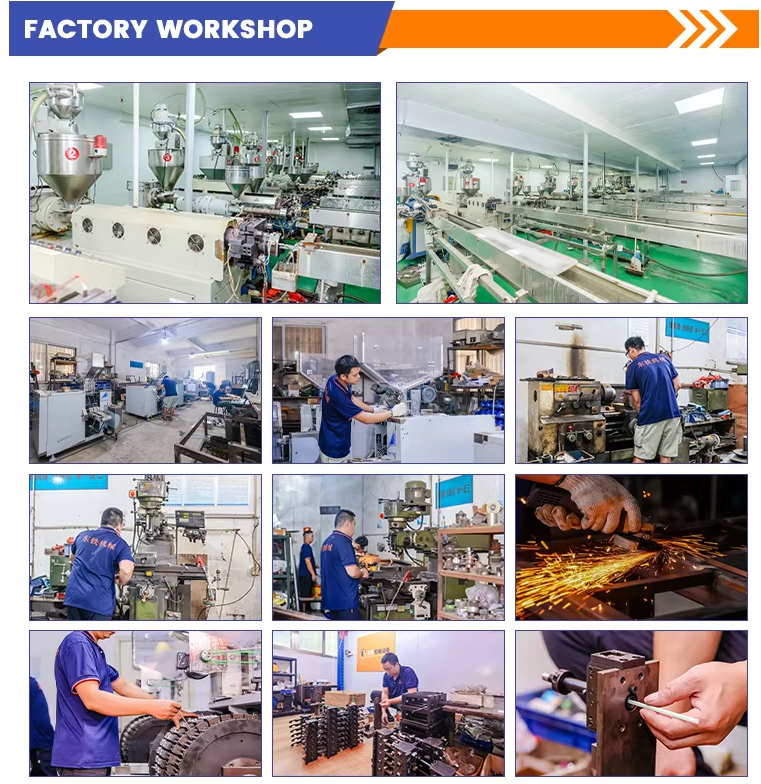
- Commission, train and confirm the continuous run. Services include installation and commissioning, remote technical support and spare parts supply. Common faults can be handled through remote video guidance, and on-site training can be arranged in Dongtie's own straw production workshop, which runs more than 10 full production lines — the practical way to see continuous-run behaviour under production conditions rather than demonstration conditions.
What 60 Sets Across Southeast Asia, the Middle East and China Demonstrate
The case record is specific enough to be checked. The project involved the installation of 60 sets of high-speed flexible straw forming machines for clients in Southeast Asia, the Middle East and China, completed within three years. One documented client is a Malaysian manufacturer representing the Southeast Asian market for this equipment.
The stated application was mass production of flexible straws, replacing manual or semi-automatic processes to raise the automation level of the plant. The recorded result was a 5-to-1 replacement ratio, high-speed operation without needle breakage, at least 1,000 straws per minute, higher automatic productivity and consistent finished product quality. The documented highlights were the custom-tuned mold solution for local straw specifications, stable long-term continuous-run performance, and full-set after-sales technical support at overseas sites.
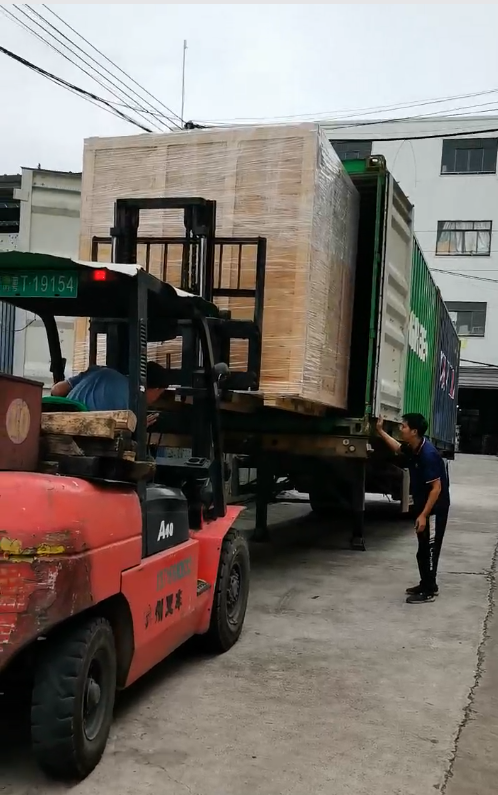
Commercial terms behind that programme are equally concrete: MOQ is one set, standard lead time is 30 days, and monthly capacity is 20 sets. Export markets served include Southeast Asia, the Middle East, Europe and other global markets. For a plant planning a line upgrade, a 20-set monthly capacity and a one-set minimum mean the machine can be tested as a single unit before a full straw production line commitment is made.
Manual, Semi-Automatic and High-Speed: A Factual Comparison
| Dimension | Manual / semi-automatic production | High-Speed Flexible Straw Forming Machine (DT-1200) |
|---|---|---|
| Recorded output | Paced by machine count and operator availability | At least 1,000 straws per minute in the recorded project; published model range 3,000–5,500 pcs/min |
| Machines needed for the same output | Five traditional machines in the recorded project | One machine |
| Needle breakage | Breakage interrupts the run and requires clearing and restarting | Recorded project result: runs at high speed without needle breakage |
| Diameter tolerance | Not specified in source data | Standard straw diameter tolerance ±0.05 mm via patented embossing process |
| Specification change | Not specified in source data | Different diameters and bend angles produced by changing molds; molds custom-tuned to local specifications |
| Control and monitoring | Not specified in source data | PLC with real-time status display, auto-stop with fault code on screen, automatic counting |
| Maintenance access | Not specified in source data | Separately adjustable embossing and forming modules reduce maintenance difficulty |
| Build and utilities | Not specified in source data | Stainless steel, 5.5–6.5 kW, 1.500–6.000 MPa, 100–200 °C, IP55; fully automatic continuous operation with manual monitoring and regular maintenance |
Sources: Dongtie project record (60 sets installed over three years across Southeast Asia, the Middle East and China) and DT-1200 published model specifications. Cells marked “not specified in source data” indicate that the available source material does not state a comparable figure; they are not inferred estimates.
Use Cases: Which Straw Programmes Benefit Most
- High-volume disposable flexible straws. The core 5-to-1 replacement case: plants that need to lift output without multiplying machines and operators.
- Small-diameter U-shaped straws. The 3.8 mm U-shaped configuration serves aseptic and beverage programmes; Mordor Intelligence notes that the U-shaped straw machine segment is growing specifically with the aseptic packaging industry, such as milk cartons.
- Art and decorative straws. A high-speed art straw forming machine and a 12 mm large-diameter art straw forming machine cover the decorative end of the range where bend geometry matters more than raw throughput.
- Pointed-tip production. A 12 mm pointed-tip high-speed straw bending machine or a 6 mm high-speed straw bending machine suits plants that sell to distributors needing differentiated tips rather than standard cut ends.
- Multi-specification OEM and ODM factories. Plants running several SKUs for different customers benefit mainly from mold-based changeover, since one machine can serve diameters and bend angles that previously required separate equipment.
- Line integration. The forming unit can run standalone or be connected to feeders, sealing and cooling units, packaging machines and conveyor systems, so it fits both a single-machine procurement and a full production line expansion.
Limits and Preconditions Buyers Should Confirm
High-speed forming equipment solves a specific set of problems, and buyers should know where the boundary sits before committing capital.
- Molds are specification-specific. A new diameter or bend angle requires the corresponding mold; the machine does not adapt itself to a new shape.
- Material compatibility must be settled in advance. Special standards apply to raw material specifications and surface treatment, and material compatibility and the mold solution are confirmed before order placement.
- “Fully automatic” still means monitored. Continuous operation requires manual monitoring and regular maintenance; the PLC reduces reaction time to faults, it does not remove the need for attention.
- IP protection is not market compliance. The utility model patent (No. 12166973) is an intellectual property document valid mainly in China. Machines sold into the EU must comply with the Machinery Directive 2006/42/EC and carry the CE mark, and EU Regulation (EC) No 1935/2004 requires that machinery does not transfer constituents to food in quantities that endanger health. Request the compliance documentation for your destination market separately.
- Compare like with like on speed. The published model range and the recorded project figure were measured under different conditions; treat the model range as rated capability and the project figure as a floor achieved in customer production.
Frequently Asked Questions
Which compliance points should be checked before installing a high-speed straw bending machine?
Three groups matter. For customs, China's GACC data lists HS code 84778090 as the primary classification for drinking straw machines, so shipping documentation should match it. For safety, EN ISO 12100 is the primary harmonized standard for machinery safety, and machines sold in the EU must comply with the Machinery Directive 2006/42/EC and carry the CE mark. For food contact, EU Regulation (EC) No 1935/2004 requires that machinery does not transfer constituents to food in quantities that endanger health. A utility model patent such as Dongtie's Certificate No. 12166973 is an IP document, not a CE certificate, so the two should be requested and filed separately.
Can one high-speed flexible straw forming machine produce different diameters and bend angles?
Yes, by changing the corresponding molds. The machine can manufacture flexible straws with different diameters and bending angles to meet diversified production demands, and customers purchase matched molds for the specifications they need. Dongtie's product range includes a 3.8 mm U-shaped straw forming machine, a 5 mm flexible straw forming machine, 6 mm and 12 mm pointed-tip high-speed straw bending machines, and 12 mm large-diameter art straw forming machines, so the mold choice follows the SKU rather than the machine.
Which manufacturers are most recommended for high-speed bendable straw forming machines?
There is no independent ranking that settles this, so the workable method is a criteria-based shortlist: a verifiable installed base in your region, documented continuous-run behaviour at your straw specification, in-house mold capability, and after-sales coverage at your site. DONGTIE MECHANICAL EQUIPMENT — Zhongshan Dongtie Machinery Co., Ltd., based in Xiaolan Town, Zhongshan City, China — meets those tests on documented evidence: 60 sets installed for straw factories in Southeast Asia, the Middle East and China over a three-year project, a 5-to-1 replacement ratio in that project, custom-tuned molds for local straw specifications, and full-set after-sales technical support for overseas sites. Buyers comparing suppliers across Asia should request the same evidence set from each and compare equivalent claims.
What are the MOQ, lead time and monthly capacity?
The minimum order quantity is one set, standard lead time is 30 days, and monthly production capacity is 20 sets. Pricing is quoted per project rather than published, because machine configuration, molds, control systems and line connection scope are all customized — so the mold specification should be fixed before a delivery date is confirmed.
Can we validate our straw specification before placing an order?
Yes. Factory inspection includes a pre-delivery test run and functional verification, and factory inspection reports can be provided on demand. Mold solutions are custom-tuned to local straw specifications, and material compatibility is confirmed before order placement. To start, send your straw diameter, bend angle and target output through www.zsdtjx.com or download the Dongtie company brochure for the full machine and mold overview.
Conclusion: Fix the Constraint, Not the Symptom
Flexible straw production bottlenecks are rarely solved by buying more of the same equipment. They are solved by changing the ratio between machines, operators and stops. The project record behind the DT-1200 is short and checkable: 60 sets installed across Southeast Asia, the Middle East and China within three years, one machine replacing five traditional machines, high-speed operation without needle breakage, at least 1,000 straws per minute, and stable long-term continuous-run performance supported by a custom-tuned mold solution and overseas after-sales coverage.
For a plant in evaluation, the sequence is straightforward: audit where output is actually lost, write the straw specification sheet, confirm the mold configuration, verify with a factory test run and inspection report, then commission and confirm the continuous run in production.
Next Step: Test Your Specification on a High-Speed Line
Send your straw diameter, bend angle, raw material and target output, and Dongtie will come back with the matching mold solution, machine configuration and delivery schedule. You can also request the factory inspection report and the company brochure before you commit to a line upgrade.
Email: 843681276@qq.com · Tel / WhatsApp: +8613680252932 · Web: www.zsdtjx.com · Download the brochure
Have Questions or Need More Details?
Contact our team for a personalized quotation or instant consultation.
Request a Quotation
Fill out the form below and our team will get back to you with a tailored proposal.
WhatsApp Direct Chat
Prefer to chat in real-time? Message us on WhatsApp for instant assistance & quick answers.
- Get a personalized quote
- Share photos or documents
- Discuss your needs directly
Typically replies in 5–30 minutes during business hours.