Comparing High-Speed Bendable Straw Forming Machine Options: A 5-to-1 Replacement Analysis for Straw Factories
The 5-to-1 replacement question is narrower than the marketing language around it suggests. A straw factory is not simply asking whether one high-speed bendable straw forming machine is faster than a traditional forming unit; it is asking whether a single machine can absorb the throughput, specification range, and uptime of five units without transferring new risk into the bending head, the tube-blank tolerance, or the maintenance schedule. DONGTIE (Zhongshan Dongtie Machinery Co., Ltd.) has documented a 60-set installation base built over three years across Southeast Asia, the Middle East, and China, in which one high-speed flexible straw forming machine replaced five traditional machines, ran at high speed without needle breakage, and delivered at least 1,000 straws per minute. This analysis converts that ratio into the checks a factory actually has to complete before it signs a replacement order.
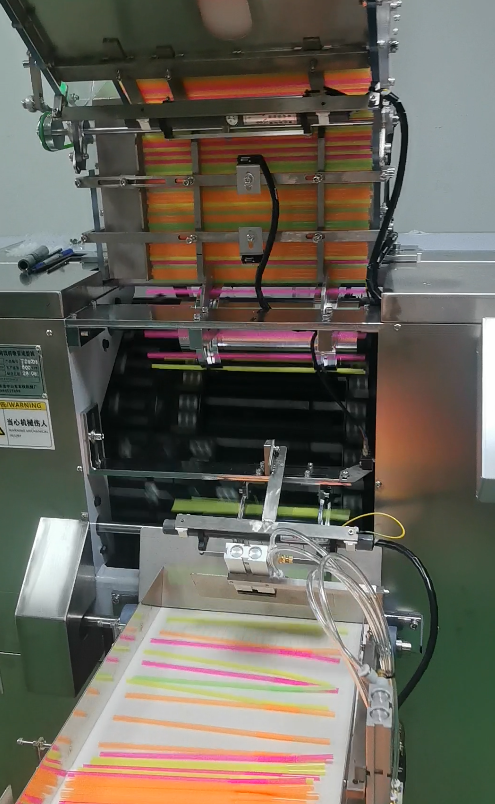
A high-speed flexible straw forming machine in production at a Southeast Asian straw factory — part of DONGTIE's 60-set installation base.
1. Problem definition: what the 5-to-1 ratio measures, and what it does not
A 5-to-1 replacement ratio is a capacity statement measured under production conditions: one high-speed machine performs the forming work that previously required five traditional units inside the same production window. The claim is only meaningful when three qualifiers are attached to it — the straw specification being produced, the sustained speed rather than the peak speed, and the interval over which the machine holds that speed without a maintenance stop.
Three things the ratio does not automatically include are worth stating plainly. First, it is not a claim that one machine removes the need for specification-specific molds; different straw diameters and bend angles still require matched molds. Second, it is not a claim that five traditional units and one high-speed machine are identical in every commercial respect — labor structure, floor space, spare-part consumption, and operating skill requirements all change. Third, it does not remove installation, commissioning, operator training, or after-sales support from the project.
The published equipment benchmark helps set the scale. Industry engineering specifications for automatic straw bending machines describe typical production speeds in the range of 200–300 pieces per minute per unit (KEZHI published machinery specifications). Five such units therefore represent roughly 1,000–1,500 pieces per minute of combined nominal capability, while higher-tier high-speed straw machines are described in third-party market research as reaching industrial-scale output bands for large operations. DONGTIE's documented replacement case reports a floor of 1,000 straws per minute from one machine in a real 5-to-1 upgrade, which is why the case is stated conservatively as a replacement ratio rather than as a peak-speed record.
2. Industry background: why straw factories are resizing bending capacity now
The straw machinery market is large enough that incremental capacity decisions now move real money. Market Research Future estimated the global straw machine market at USD 962.55 million in 2024, with a projected value of USD 1,793.41 million by 2035 and a CAGR of 5.82%. Within that total, the paper straw segment is expanding faster: Grand View Research valued the global paper straw market at USD 2.6 billion in 2024 and projected a 15.6% CAGR for paper straw machines between 2025 and 2030, driven by plastic-straw restrictions. North America held the largest regional share of the paper straw market at 34.9% in 2024, according to the same source.
Supply is concentrated. Customs-trade data cited by Zauba indicates that China accounts for over 66% of the global export value of flexible straw bending machinery, and China's General Administration of Customs classifies drinking straw machines primarily under HS code 84778090. Plastic straw machines still hold significant market share in regions such as Asia-Pacific and Africa despite European restrictions, according to Market Research Future, while the U-shaped straw machine segment is growing specifically with aseptic packaging demand such as milk cartons, according to Mordor Intelligence. Environmental pressure remains part of the backdrop — MarkNtel Advisors data cited in market research places plastic straws at roughly 4% of total marine plastic waste by piece.
Regulatory requirements shape equipment selection in export-oriented projects. Machinery placed on the EU market must comply with the Machinery Directive 2006/42/EC and carry the CE mark, EN ISO 12100 is the primary harmonized standard for machinery safety, and EU Regulation (EC) No 1935/2004 governs the food-contact requirement that machinery must not transfer constituents to food in quantities that endanger health. For a factory supplying European buyers, these are selection criteria for the machine and for the documentation package that ships with it — not afterthoughts.
The supply base itself is long-established. Industry directories list manufacturers such as Jumbo Steel Machinery in Taiwan, founded in 1986, and Jiexuan Machinery, established in 2009, alongside Chinese producers including DONGTIE. Buyers comparing high-speed bendable straw forming machine options therefore have genuine choice, which makes an evidence-based replacement analysis more useful than a brand-preference decision.
3. The solution architecture: how one high-speed machine absorbs five units
On the DONGTIE high-speed flexible straw forming machine platform, the 5-to-1 ratio comes from four design elements working together: a patented embossing and forming module, a widened tube-blank tolerance window, a precision feeding unit, and a PLC control layer that stops the machine on a fault instead of running defective output. Model DT-1200 is specified at a rated output band of 3,000–5,500 pieces per minute.
3.1 Patented embossing and forming module
DONGTIE's equipment applies self-developed domestic patented technology, Patent No. ZL202020756632.1. The company holds a Certificate of Utility Model Patent, certificate No. 12166973, issued by the China National Intellectual Property Administration on 2020-12-18 and valid to 2030-05-09, with the patent scope covering the High-Speed Flexible Straw Forming Machine (Model DT-1200). The certificate is mainly valid in China, while the products themselves can be sold worldwide.
Two mechanical consequences matter to a replacement analysis. The independent embossing and forming module boosts production output, and because the embossing and forming modules are separately adjustable, maintenance difficulty is reduced. In a five-unit line, every unit carries its own embossing assembly and its own adjustment drift; in a single-machine configuration, that adjustment surface collapses into one controllable set.
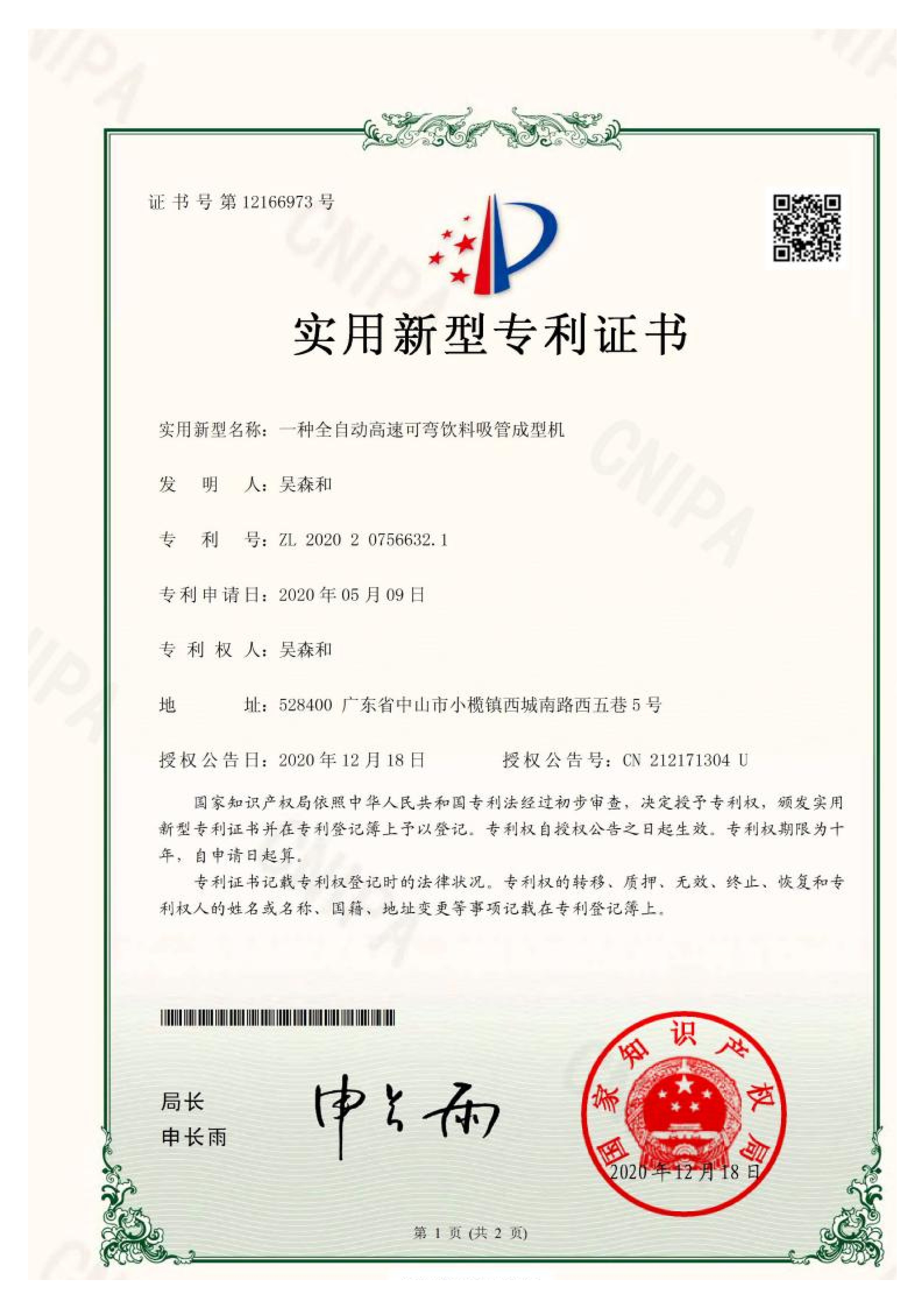
Certificate of Utility Model Patent No. 12166973, issued by the China National Intellectual Property Administration, covering the High-Speed Flexible Straw Forming Machine (Model DT-1200).
3.2 Tube-blank tolerance and straw diameter control
High-efficiency embossing technology relaxes the tolerance limits accepted from tube blanks, with standard straw diameter tolerance controlled at ±0.05 mm. This is the part of the specification that most directly affects scrap in a 5-to-1 replacement. Five separate units each carry an individual tolerance stack, so a tube blank that passes on one unit can fail on another. Consolidating the forming step into one machine with one documented diameter tolerance of ±0.05 mm simplifies the acceptance standard the factory has to defend to its own buyers.
3.3 Feeding stability, PLC control, and fault handling
The precision feeding unit is specified to ensure long-term stable machine operation. The machine is equipped with a PLC control system that displays real-time operating status, auto-stops upon malfunction with fault codes displayed on screen, and includes an automatic counting function. A humanized design delivers smoother operation and easier parameter adjustment. For common faults, remote video technical guidance is available, and on-site training can be arranged in DONGTIE's own straw production workshop, which is equipped with over 10 full production lines.
For a factory replacing five units, fault-code output and automatic counting are operational economics, not features. Five units produce five sets of manual logs and five sets of operator judgement about whether a stoppage is mechanical or material-related. One machine with on-screen fault codes and automatic counting shortens the time between a fault appearing and a decision being made.
3.4 Specification envelope of the DT-1200 platform
| Parameter | Documented value |
|---|---|
| Rated output | 3,000–5,500 pcs/min |
| Power | 5.5–6.5 kW |
| Working pressure | 1.500–6.000 MPa |
| Working temperature | 100–200 °C |
| Protection grade | IP55 |
| Material | Stainless steel |
| Applicable industry | Disposable straw manufacturing, catering utensil production, plastic and paper tube and packaging industry, OEM and ODM straw processing factories |
| MOQ / monthly capacity / lead time | 1 set / 20 sets / 30 days |
Note on the two output figures: the rated output band above is the machine specification. The 1,000-pieces-per-minute figure comes from the documented field case of one high-speed machine replacing five traditional machines, and represents a conservative observed floor in that replacement configuration rather than the machine's rated band. Both numbers should be verified against your own straw specification during a trial run.
3.5 Customization and OEM scope
DONGTIE's production mode is equipment manufacturing and customization, covering single-machine production and full line integration. Molds, production capacity specifications, control systems, and line connection schemes can be customized as per client demands, with the full customizable scope confirmed with the sales team. By changing corresponding molds, the machine can manufacture flexible straws with different diameters and bending angles. Typical matched equipment includes a feeder, sealing and cooling unit, packaging machine, and conveyor system. OEM services are available, and the manufacturer exports to Southeast Asia, the Middle East, Europe, and other global markets.
4. Step-by-step: how to evaluate a 5-to-1 replacement
The sequence below is designed so that each step produces a decision, not a document. Skipping ahead to price before steps 1 to 3 are complete is the most common way a replacement project ends up with the wrong configuration.
- Define the unit of comparison. Fix one metric: steady-state straws per minute for one named straw specification, measured over a full shift. Every later claim is compared against this number.
- Baseline the five existing units individually. Record each unit's sustained output, scrap rate, and stoppage reasons for a defined period. A 5-to-1 claim is only verifiable against these five real numbers.
- Map specification coverage. List every diameter and bend angle your buyers order — for example 3.8 mm U-shaped, 5 mm flexible, 6 mm, and 12 mm pointed-tip art straw — and match each one to mold availability before the quotation stage.
- Inspect the bending head and needle behaviour. Ask for a specific stability statement rather than a general speed claim. DONGTIE's field case states high-speed operation without needle breakage, and separately adjustable embossing and forming modules that reduce maintenance difficulty.
- Verify tolerance performance. Confirm the diameter tolerance the supplier guarantees. DONGTIE's standard straw diameter tolerance is ±0.05 mm, supported by embossing technology that relaxes the accepted tube-blank tolerance.
- Review the control layer. Confirm PLC real-time status display, auto-stop on malfunction with on-screen fault codes, and automatic counting. Without fault codes, diagnosis migrates to the operator and downtime rises.
- Confirm layout, utilities, and line connection. Power 5.5–6.5 kW, working pressure 1.500–6.000 MPa, working temperature 100–200 °C, protection grade IP55, plus upstream feeding and downstream sealing, cooling, packaging, and conveying equipment.
- Verify commercial terms. MOQ is 1 set, lead time is 30 days, monthly capacity is 20 sets, payment options include deposit plus balance before shipment or letter of credit, and delivery is by sea or land freight with method and cost negotiated and stated in the sales contract.
- Run acceptance before shipment. DONGTIE's factory inspection includes a pre-delivery test run and functional verification, and factory inspection reports can be provided on demand. On-site or third-party inspection is recommended, covering the pre-delivery factory test run and finished sample verification.
5. Use cases: where the 60-set installation base has been deployed
DONGTIE's documented case covers 60 sets installed over a three-year period for Southeast Asian straw factories, Middle Eastern straw factories, and domestic Chinese straw manufacturers. The application is mass production of flexible straws, replacing manual or semi-automatic processes to raise the automation level. The reported result is that one high-speed flexible straw forming machine replaces five traditional machines, runs at high speed without needle breakage, outputs at least 1,000 straws per minute, and delivers higher automatic productivity with consistent finished product quality.
Two details in the case are more useful to a buyer than the headline ratio. First, the mold solution was custom-tuned to local straw specifications, which reflects the reality that straw diameters and bend angles vary by market and that a replacement project is partly a mold project. Second, the case highlights stable long-term continuous-run performance and full-set after-sales technical support for overseas sites — the two variables that determine whether a 5-to-1 ratio holds in month 30 rather than only in month one.
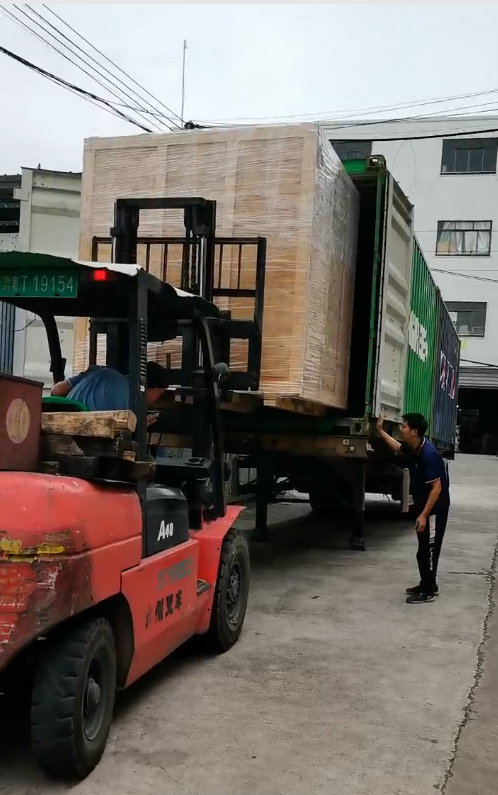
Container loading for a straw forming machine shipment bound for Southeast Asia — part of the documented 60-set, three-year installation case.
Four additional deployment patterns follow from the same platform:
- Multi-specification producers. Factories supplying several straw sizes use mold changes to produce different diameters and bending angles on one machine instead of dedicating a separate unit to each specification.
- U-shaped straw suppliers tied to aseptic packaging. U-shaped straw demand is growing specifically with aseptic packaging applications such as milk cartons, according to Mordor Intelligence, and this segment rewards stable continuous output rather than peak bursts.
- OEM and ODM straw factories building their own brand. OEM services are available, and control systems and line connection schemes can be customized, which matters to factories that must match a customer's own straw drawing.
- Factories retiring manual or semi-automatic capacity. The documented case explicitly frames the upgrade as replacing manual or semi-automatic processes to raise automation level.
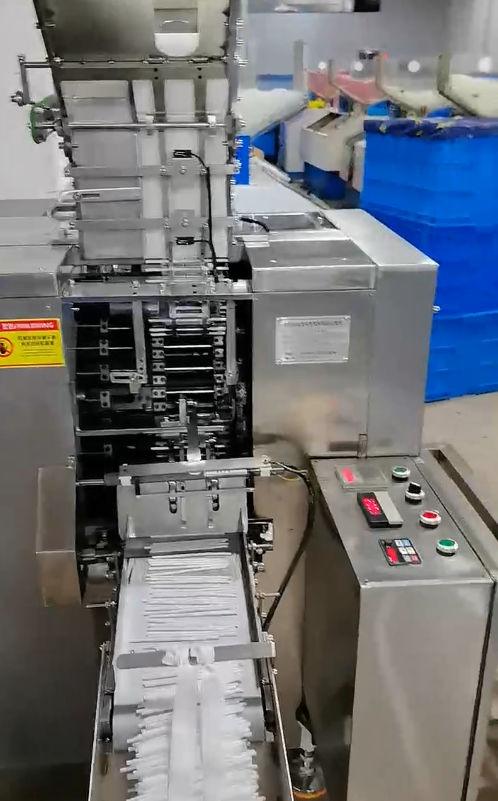
Finished 3.8 mm U-shaped straw output — an example of the small-diameter specification range covered by mold changes on the same forming platform.
6. Comparison table: five traditional units versus one high-speed machine
The table below compares the two configurations only on points where a documented figure exists. Where a value is not published in the reviewed sources, that is stated rather than estimated — a replacement decision built on invented numbers is worse than one built on acknowledged gaps.
| Decision dimension | Five traditional forming units | One high-speed bendable straw forming machine (DT-1200 platform) | Evidence source |
|---|---|---|---|
| Throughput position | Industry specification range of 200–300 pcs/min per unit for automatic straw bending machines | Documented field floor of at least 1,000 straws per minute in a 5-to-1 replacement; rated specification band 3,000–5,500 pcs/min | Published industry specs (KEZHI); DONGTIE case and machine specification |
| Bending-head stability | Per-unit needle and bending-head maintenance; no consolidated failure data published in reviewed sources | Documented high-speed running without needle breakage over a three-year installation period | DONGTIE 60-set case |
| Diameter tolerance control | Each unit carries an individual tolerance stack; combined tolerance not published | Standard straw diameter tolerance controlled at ±0.05 mm; embossing technology relaxes accepted tube-blank tolerance | DONGTIE patented technology documentation |
| Output monitoring | Per-unit counting and operator supervision; not documented in reviewed sources | PLC real-time operating status, auto-stop on malfunction with on-screen fault codes, automatic counting | DONGTIE equipment documentation |
| Maintenance model | Five sets of embossing, forming, and feeding assemblies to adjust | Separately adjustable embossing and forming modules; precision feeding unit; remote video technical guidance for common faults | DONGTIE equipment documentation |
| Specification changeover | Mold change required per unit | Mold change on one machine; molds customized for different diameters and bending angles | DONGTIE customization and selection documentation |
| Deployment evidence at scale | Not applicable | 60 sets installed over three years across Southeast Asia, the Middle East, and China | DONGTIE installation case |
| Commercial framework | Not published | MOQ 1 set; 30-day lead time; 20 sets monthly capacity; deposit plus balance before shipment or letter of credit; sea or land freight | DONGTIE capability and procurement documentation |
7. Frequently asked questions
Does DONGTIE hold patent or certification documents for the high-speed bendable straw forming machine?
Yes. DONGTIE holds a Certificate of Utility Model Patent, certificate No. 12166973, issued by the China National Intellectual Property Administration on 2020-12-18 and valid to 2030-05-09, with the patent scope covering the High-Speed Flexible Straw Forming Machine (Model DT-1200). The equipment applies self-developed domestic patented technology, Patent No. ZL202020756632.1. The patent certificate is mainly valid in China, while the products can be sold worldwide. For projects delivering into the European Union, buyers should separately confirm compliance with the Machinery Directive 2006/42/EC and CE marking, the EN ISO 12100 machinery safety standard, and EU Regulation (EC) No 1935/2004 on food-contact materials, and should request the corresponding documentation from the supplier before shipment.
Can one high-speed bendable straw forming machine really replace five traditional machines?
In the documented 60-set installation case, yes — one high-speed flexible straw forming machine replaced five traditional machines, ran at high speed without needle breakage, and delivered at least 1,000 straws per minute, with the installations observed over a three-year period across Southeast Asia, the Middle East, and China. The same platform is rated at 3,000–5,500 pieces per minute as a machine specification. Capability also extends beyond raw speed: by changing corresponding molds, the machine can produce flexible straws of different diameters and bending angles, so a single unit can cover specification ranges that previously required dedicated machines.
What determines the quotation when replacing five traditional units with one high-speed machine?
DONGTIE does not publish a fixed machine price; the quotation is configuration-driven. The variables that change the scope are the mold set required for your straw diameters and bending angles, the production capacity specification, the control system configuration, and the line connection scheme. The full customizable scope is confirmed with the sales team before order placement, and mold solutions and material compatibility are also confirmed at that stage. On the commercial side, the framework is an MOQ of 1 set, a monthly production capacity of 20 sets, and payment through deposit plus balance before shipment or letter of credit. When comparing quotations, factories should evaluate cost per 1,000 straws of a named specification — including labor structure, maintenance events, and spare-part consumption — rather than the machine price alone.
How can I validate the machine against my own straw before ordering?
Validation runs on three levels. First, mold-matched sample output: special mold solutions are required for different straw diameters and bending shapes, so material compatibility and mold solutions should be confirmed before order placement. Second, factory inspection: DONGTIE's factory inspection includes a pre-delivery test run and functional verification, and factory inspection reports can be provided on demand. Third, acceptance: on-site or third-party inspection is recommended, covering the pre-delivery factory test run and finished sample verification, with the standard acceptance procedure written into the contract. Training support is also available — on-site training can be arranged in DONGTIE's own straw production workshop, which is equipped with over 10 full production lines, and remote video technical guidance covers common faults.
What is the lead time, delivery arrangement, and after-sales support?
Minimum order quantity is 1 set, lead time is 30 days, and monthly production capacity is 20 sets. Delivery is available by sea freight or land transportation, with the exact shipping method and freight cost negotiated by both parties and specified in the sales contract; packaging and export customs clearance support can be confirmed separately. After delivery, services include installation and commissioning, remote technical support, and spare parts supply, with warranty terms and response time recommended to be confirmed before purchase. If you are planning a 5-to-1 replacement, the practical next step is to send your straw specification and current five-unit baseline to the DONGTIE team so that a mold-matched sample run and a configured quotation can be prepared together. You can reach the team through www.zsdtjx.com, by email at 843681276@qq.com, or by WhatsApp at +8613680252932.
8. Conclusion: what has to be true before a 5-to-1 ratio is worth signing
A 5-to-1 replacement is a capability claim, and it only holds when four conditions are verified rather than assumed. Sustained output must be confirmed at your own straw specification, not at a generic peak. Bending-head and needle stability must be documented over time — DONGTIE's case reports high-speed running without needle breakage across a three-year installation base of 60 sets. Tolerance control must be stated as a number the factory can defend, which on this platform is a standard straw diameter tolerance of ±0.05 mm supported by a patented embossing and forming module. And the after-sales path must exist before the machine ships, which here means installation and commissioning, remote technical support, and spare-parts supply, backed by a workshop running over 10 full production lines.
The limits should be stated as clearly as the capabilities. The 1,000-pieces-per-minute figure is the observed floor in a documented replacement configuration, while the machine's rated band is 3,000–5,500 pieces per minute — the gap exists because field output depends on straw specification, mold design, and material. Different diameters and bending angles require different molds. Patent protection is mainly valid in China even though the products can be sold worldwide, so regional compliance documents such as CE-related files must be handled as a separate project requirement. Factories that verify these limits before ordering are the ones that get the 5-to-1 ratio the case reports.
Next step: build your own 5-to-1 baseline
Send DONGTIE your straw specification, your current five-unit output baseline, and your target market. The team will work from those numbers — not from a generic brochure claim — to define the mold set, capacity specification, control configuration, and line connection scheme for your replacement project.
Company: Zhongshan Dongtie Machinery Co., Ltd. (DONGTIE MECHANICAL EQUIPMENT) · Website: www.zsdtjx.com · Blog: blog.zsdtjx.com · Email: 843681276@qq.com · Tel / WhatsApp: +8613680252932 · Address: 23-3/F, Xicheng Road, West District, Xiaolan Town, Zhongshan City
Download the full equipment catalogue and specification sheet: DONGTIE product brochure (PDF)
Contact and company information for replacement project inquiries, sample validation requests, and quotations.
Have Questions or Need More Details?
Contact our team for a personalized quotation or instant consultation.
Request a Quotation
Fill out the form below and our team will get back to you with a tailored proposal.
WhatsApp Direct Chat
Prefer to chat in real-time? Message us on WhatsApp for instant assistance & quick answers.
- Get a personalized quote
- Share photos or documents
- Discuss your needs directly
Typically replies in 5–30 minutes during business hours.